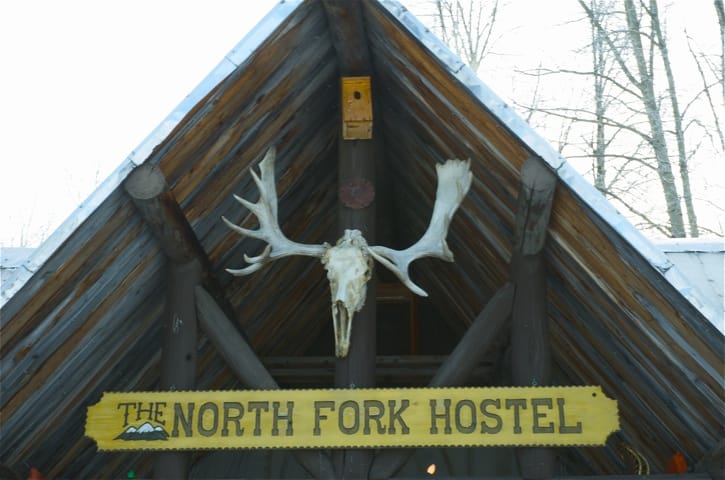
Facilities include thirteen bunks for men and women, the downstairs dormitory sleeps up to four people and the upstairs dormitory can sleep up to seven people. Then there are also three overflow beds in the hallway upstairs.
Author: Oliver Meister
Come and visit us @ the North Fork Hostel & Inn
activities
 No matter what your activity, bring your camera and binoculars. Wildlife is plentiful here. You might see deer, moose, elk, mountain lions, wolves, eagles or bears from the hostel windows. Only wolverines have not been seen from the hostel windows yet.
Hike or backpack along Glacier’s Continental Divide or the forested trails of the Whitefish Range.
Ski Logan Pass in late June when Going-To-The-Sun Road opens. (Cross-country skis and boots may be rented at the hostel.
Bicycle up from West Glacier on the inside park road to the hostel, then explore Polebridge and the surrounding area.
Fish or swim the federally designated wild and scenic North Fork of the Flathead River or beautiful Kintla and Bowman Lakes.
Help with trail maintenance, go on a hike or attend one of the other activities sponsored by the North Fork Preservation Association.
private rooms upstairs

Upstairs we have a private room, formerly known as the family room. It combines the convenience of being inside the main lodge and having your private space. The only challenge you have to face are the very steep stairs, especially on a nightly trip to the outhouse.
This room has two full size beds, which means plenty of room for a couple or a two individuals!
$80 + tax a weeknight for two, occupancy 2-4 people (add $30 for each additional person). Add $10 a night for Friday and Saturday nights.
The outhouses
 ¡Outhouses!:
No plastic or hygiene products in pit please, they belong in trash. Human waste only
Keep lid closed!
And: It is OK to pee in the woods! Birds do it, bears do it, moose do it, why not you?
Also: Remember: Changing toilet paper rolls does not cause brain damage!

Bedding and towels
Sheets and Towels are normally not provided but can are available (Ask for help) for a small charge;
Always use bedding or sleeping bags!

Pillow cases (No charge) are next to the kitchen in the Hallway;
Please return pillow cases and sheets to hamper after use. Hang towels to dry!
The shower
 Shower hours: 7 AM to 5 AM and 5 PM to 10 PM
(Please, respect quiet times; hot water may not be available after hours)
The shower has an electric light, you find the switch to the left of the light fixture above the sink.
Conserve water: We are in a fragile environment: Low groundwater table & flood plain, so please limit your time and water use, be respectful to those after you and use squeegee after each use.
Please prop door open with little stool so the room can air out.
The Green Zucchini
 Another small little gem for the financially challenged is the “Green Zucchini” also called pickle by some. A homemade trailer from the ’50s that barely survived the ’95 flood. Because it has drafty windows and no heat it is only available during July and August. The bed just barely big enough for two has been my home for many summers during my early time but it still enamors special visitors.


The kitchen
 Kitchen hours: 7 AM to 10 PM (Please, respect quiet times)

Clean up after yourself and be respectful to others;
There are 2 guest refrigerators for your use in the kitchen, please mark and date all your food and let us know if you leave foodstuff behind, so it does not go bad.
Please wash all your dishes and wipe counter and stove tops after use; Use blue tubs to do dishes in, fill the rinse tub first so hot water can reach the kitchen, then fill the wash tub (staff will fill the sanitizer tub), it helps to conserve water and energy, Thanks!


How to use propane lights properly
 How to light propane lamps: Please familiarize yourself with them first and ask for assistance if in doubt: First light match (make sure you have a solid and big flame) hold it to the mantle (make sure only the flame, not the match is touching the mantle) and turn gas on (lever/ knob on side of lamp) For your safety, do not turn gas on first and do not blow light out!
check in, check out

| Check in between 5:30 PM and 9 PM Make prior arrangements if you need a late check-in! |
| Check out before 10 AM Please, leave room or cabin as you found it. Return pillowcases, etc. to hamper. |
| Electricity: We get our power from the sun but our system is fairly small. We encourage you to use the electric lights (especially until you get used to the propane lights) and prefer it in the wash and shower room. Please, always turn all lights OFF after use. Charging power for your devices only works during the power hour. (check with Oliver, usually between 7 & 8 PM) |
| Shower hours: 7 AM to 10 AM and 5 PM to 10 PM (Hot water not always available) The shower has electric light, you find the switch to the left of the light fixtures above the sink. Please conserve water: We are in a fragile environment: Low groundwater table & flood plains. So, limit your time and water use, be respectful to those after you and use squeegee after each use; Please keep shower door propped open so air can circulate. Shower for hostel guests only. |
| Kitchen hours: 7 AM to 10 AM and 5 PM to 10 PM (Please, respect quiet times) Always clean up after yourself and be respectful to others; There is a guest refrigerator for your use. Please mark and date all your food. If you leave foodstuff behind date and mark “free” so it can be safely shared with other guests. Wash all your dishes, wipe counter and stove top immediately after use! Use blue tubs. Wash, Rinse, Sanitize. Help conserve water and energy! |
| Please recycle: Aluminum cans in blue recycle bin. Glass bottles in card board box, there is no glass recycling but it makes life easier as we have to haul all garbage to Columbia Falls; Egg shells (they compost better if burned) and paper in paper bag. Because this is bear country please no cooked or processed FOOD scraps in compost pail – only coffee, tea and raw, uncooked matters (in doubt throw in trash or ask Oliver). |
| How to light propane lamps: Please familiarize yourself with them first and ask for assistance if in doubt: First light match (make sure you have a solid and big flame) hold it to the mantle (make sure only the flame, not the match, is touching the mantle) and turn gas on (lever/ knob on side of lamp) For your safety, do not turn gas on first and do not blow out! Oliver loves to show you how to light the lamps safely! |
| Sheets and Towels are normally not provided but are available (Ask for help) for a fee! Always use bedding or sleeping bags! Pillow cases (No charge) are next to the kitchen in the Hallway; Please return pillow cases and sheets to hamper after use. Hang towels to dry. |
| Toilets are Outhouses! You find them in backyard, there is also a urinal! Only toilet paper and human waste goes down the hole! Absolutely no plastic or hygiene products in pit please, they belong in the trash! Keep lid closed to keep smell down and remember: Changing toilet paper rolls does not cause brain damage! |
directions
 The North Fork Hostel & Inn is located on the western edge of Glacier National Park, 1/4 mile (1/2 kilometer) southeast of the Polebridge Mercantile at the end of Beaver Drive (follow the signs). Taking Camas Creek Road through Glacier Park (except when the park is snowed in during the winter) avoids a rough section of the North Fork Road. The North Fork Road north from Columbia Falls to Polebridge is route 486, a gravel road with sections of pavement. In winter when coming from West Glacier, use Blankenship Bridge Road( call ahead for directions). It is a good idea to have tire chains with you in winter. Try to arrive during daytime to appreciate the views and to locate the North Fork Hostel & Inn easily.
The Square Peg Ranch is about 500 yards north of the Polebridge intersections on the left side, but stop at the hostel first and pick up your key.
[cetsEmbedGmap src=http://maps.google.com/maps?hl=en&ie=UTF8&hq=&hnear=Polebridge,+Columbia+Falls,+Flathead,+Montana&ll=48.763544,-114.280987&spn=0.007864,0.01929&t=h&z=16 width=350 height=425 marginwidth=0 marginheight=0 frameborder=0 scrolling=yes]
the hostel
 What you’ll find at the North Fork Hostel & Inn include twelve bunks for men and women, couples and family accommodations, washroom and a hot shower.
A large downstairs shared living room, a warm and pleasant, fully-equipped community kitchen and the spiffiest outhouses on the North Fork. (The interior art is interesting — look for John’s college diploma.)
Behind the Inn are small cabins that are private bedrooms. (Goat Chalet, Klondike Kate’s and the Green Zucchini) You still use the facilities in the hostel. The Goat Chalet has a queen size bed, perfect for a couple; Klondike Kate’s has a queen size bed and a futon couch, ideal for a small family or two individuals; the Green Zucchini has a full size mattress, works great for a couple or individual! Also, there are two log homes for rent up the road at the Square Peg Ranch.

Don’t forget to bring linen or sleeping bags, flashlights and food. Clean sheets can be rented at the hostel. There are plenty of blankets and a few down comforters.
check in between 5pm and 10pm and check out before 10am